
Our Story
Why Sentinels Sustainability Foundation Exists
Born from the Hills. Built for the World.
There is a moment — different for every person — when the life you are living and the life you are meant to live suddenly point in the same direction.
A Childhood That Belonged to the Forest
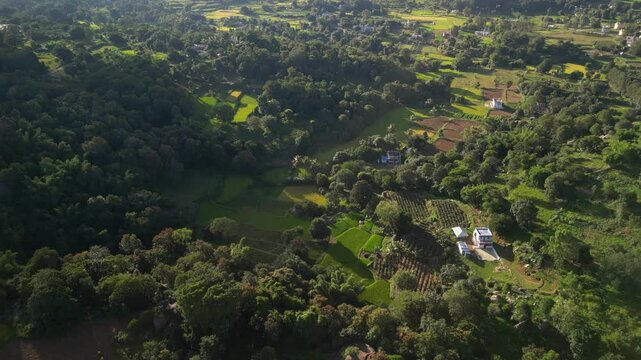
My name is Divyesh P. I grew up in Yelagiri Hills — a place tucked into the Eastern Ghats of Tamil Nadu that most people know as a weekend escape. I knew it as something else entirely: home.
Not the kind of home that is four walls and a roof. The kind of home that is a living, breathing world. Mist that rolled through the valleys every morning like it had somewhere to be. Rain that smelled of something ancient when it hit the earth. Birds I could name before I could solve an algebra problem. Trees that had been standing longer than anyone I knew had been alive.
I completed every year of my schooling in Yelagiri. The forest was my first teacher — patient, generous, and quietly extraordinary. I grew up understanding, without being told, that the land around me was not a backdrop to human life. It was life. And everything else — the food, the water, the air, the very temperature of the morning — flowed from it.
That understanding did not feel like knowledge then. It felt like ordinary. It felt like home.
I didn’t know yet that it was the most important thing I would ever learn.
The Education That Sharpened Everything
I left Yelagiri to pursue my BSc in Agriculture in Uttarakhand — another mountain world, another layered ecosystem, another reminder of how much the earth gives when it is left to function as it was designed to.
But those years did something more than give me a degree. They gave me a framework. I began to understand — scientifically, systematically — the mechanisms behind what I had felt instinctively as a child. Why forests regulate temperature. How tree cover determines water availability. What happens, precisely, to biodiversity when habitat is fragmented by unplanned development. What the data says about the speed at which these things collapse, and the extraordinary, painful slowness at which they recover.
I graduated with more than agriculture. I graduated with a question I couldn’t put down:
What are we doing to the systems that everything — including us — depends on?
Coming Home to a Home That Had Changed
Years later, I returned to Yelagiri.
I expected to exhale. To feel, again, what I had always felt here — that particular ease of being somewhere that fits you completely.
Instead, I felt something I was not prepared for. A quiet, low-frequency grief.
The hills were still there. But they had changed in the way that only someone who grew up in a place can truly notice. Summer temperatures had crept upward in a place that was never supposed to feel this warm. The number of concrete structures had multiplied — hotels, resorts, homestays — spreading across hillsides that once held only trees. Plastic waste had found its pathway into streams that were once clean enough to cup your hands into and drink. The tree line had thinned. The mornings were quieter — not a peaceful quiet, but an empty one. The birds were missing.
And beneath all of it, the numbers told a story that the scenery was trying to hide.
Research on the Eastern Ghats shows that unregulated tourism, untreated sewage, and habitat fragmentation are steadily dismantling one of India’s most significant biodiversity corridors. Studies on forest health in the Yelagiri region have found that over half of certain native tree populations are already under stress. Endemic species — organisms found nowhere else on this planet — are losing ground to development and a warming climate faster than most people realize. The forest that once felt permanent was revealing, in data, that it was not.
The place that had built me was being quietly taken apart.
I had two choices. I could hold the grief privately — the way most people do — and move on. Or I could ask what the sum of my life had been preparing me to do.
I chose the second thing.
The Idea That Became a Foundation
I didn’t want to start a conversation. I wanted to build an institution — something with roots deep enough to do real work over real time.
I didn’t have to look far. The right people had already been shaped by the same kind of world.
Anandan B had walked the same forests I had. We shared the same childhood mornings in Yelagiri — the same mist, the same trees, the same unspoken knowledge of what this land was and what it was becoming. When I told him what I was thinking, he didn’t ask me to convince him. He already knew. Some things don’t require explanation between people who grew up in the same place — they only require one of you to say it out loud first.
Rishanth Jonas had grown up in Ooty — another hill station, another extraordinary ecosystem caught between its natural identity and the relentless pressure of tourism and unplanned development. He knew what it felt like to belong to a place the world visits but rarely protects. He carried the same quiet protectiveness, the same intimate knowledge of what a hill town looks like when it is being slowly altered beyond recognition. His was not borrowed concern — it was the same lived experience, from a different set of hills.
Javidh Miandhath J had grown up in a village — close to the ground, close to the rhythms of soil and seasons, with an understanding of rural communities and the land they depend on that no university can teach. He brought something the rest of us felt instinctively but needed given form: the grounded, patient wisdom of someone who has watched humans and nature coexist for generations, and knows precisely what fractures when that relationship is broken.
Four people. Four childhoods spent in places the world calls beautiful and then slowly dismantles — hills, hill stations, and villages, each carrying its own version of the same wound. Between us, we had the mist of the Eastern Ghats, the slopes of the Nilgiris, and the soil of a Tamil village. Every landscape the Sentinels Sustainability Foundation would set out to protect already lived in someone in that room.
We hadn’t planned it that way. But looking back, it could not have been any other way.
We had a shared fury, a collective tenderness for this earth, and the particular restlessness of people who know that caring about something — and doing nothing about it — is its own quiet kind of failure.
In 2026, we registered the Sentinels Sustainability Foundation as a Section 8 Company.
But before we could decide what to register under, we had to sit with a question that changed everything.
One Problem. Four Truths.
I walked into this founding process with a single mandate: Environment. But as we asked harder questions, the answers unexpectedly broadened our mission.
- Tribal Welfare: The tribal communities of the Eastern Ghats hold centuries of vital ecological intelligence. You cannot restore a forest while ignoring the people who have always known it best. Tribal welfare is environmental work.
- Education: Children are inheriting land they haven’t been taught to understand. Planting trees without planting awareness changes nothing for the future. Education is environmental work.
- Health: Environmental degradation directly causes human illness through extreme heat and contaminated water. Clinics cannot cure a sick ecosystem. Health is environmental work.
This is how four pillars—Environment, Education, Tribal Welfare, and Health—became one foundation.
Why Sentinels?
The name was the last thing we decided. And the most deliberate.
A Sentinel is a guardian — someone who stands watch at the threshold not out of fear, but out of commitment. Every tradition across human history has had them: the ones who stayed awake when everyone else slept. Who noticed the change before it became a crisis. Who sounded the alarm not in panic, but with the steady clarity of someone who has been watching carefully for a long time and knows exactly what they are seeing.
In ecology, sentinel species do precisely this. They are the first to register environmental stress — the organisms whose health or disappearance tells the story of an entire ecosystem before that story becomes irreversible. When certain birds fall silent, when a pollinator vanishes from a meadow, when a forest spring runs dry for the first time in living memory — a sentinel has already been signalling. We just have to know how to listen.
We chose this name because it describes, without embellishment, what we intend to be.
Not outsiders arriving to rescue something from a comfortable distance. People who grew up inside these hills, these communities, these ecosystems — who feel their changes not as data points but as personal losses — standing watch, sounding the alarm, and refusing to look away until the work is done.
Beyond Yelagiri — Wherever the Earth Needs a Voice
Yelagiri is where this story began. But it is not where it ends.
The forces threatening the Eastern Ghats are not local. They are the same forces degrading forests across Tamil Nadu, hollowing out ecosystems across India, and accelerating the unravelling of natural systems across the world. Deforestation does not stop at district boundaries. Climate change does not respect state lines. The loss of a species in one corridor sends ripples through ecological networks that span continents.
The Sentinels Sustainability Foundation was born in the hills of Tamil Nadu. But its mandate is wherever the work needs doing — across Tamil Nadu, across India, and wherever in the world our reach and our resources allow us to make a difference. We will go where the forests are disappearing, where communities are losing their ecological foundation, where the alarm needs someone to sound it and no one yet has.
We are building an organization without a ceiling on its ambition and without any illusion about how hard the work will be.
What We Believe
We believe that sustainability is not a trend. It is survival — and survival does not negotiate with timelines.
We believe that the forests, the air, the water, and the soil are not resources to be managed. They are systems to be understood, respected, and — where we have failed them — restored.
We believe that people who grow up inside functioning ecosystems are not sentimental. They are informed. And that information, combined with the right institutional structure, becomes something powerful.
We believe that urgent problems are not hopeless problems. They are problems that simply require people willing to treat them with the seriousness they deserve.
There are many organizations doing good work. We do not doubt that. But we felt — clearly, stubbornly, without apology — that a voice rooted in the Eastern Ghats, carrying the specific lived experience of watching these places change and refusing to accept that change as inevitable, was a voice that needed to exist.
It did not exist.
So we built it.
The Road Ahead
The Sentinels Sustainability Foundation was founded in 2026. But its roots go back much further — to a child in Yelagiri who learned the names of trees before the names of capitals. To a student in Uttarakhand who began to understand, scientifically, what that forest had always been teaching. To a homecoming that broke something open and demanded a response.
To four people who sat in a room and understood, together, that loving a place is not enough. That love, without action, is just grief with a prettier name.
We are just beginning.
But we are beginning with clear eyes, deep roots, and something no grant can manufacture and no government can assign — a genuine, bone-deep love for this earth, and the specific, focused resolve of people who have watched it suffer needlessly and chosen, finally, to act.
If you share that resolve — this is where you belong.
The earth is still speaking. We are learning to be worthy of listening.
Divyesh P — Founder
Anandan B | Rishanth Jonas | Javidh Miandhath J — Co-Founders
Sentinels Sustainability Foundation
Section 8 Company | Est. 2026